A Hungry Traveler's Guide to Eating Like a Yomitan Local
Let's be honest — most American visitors to Okinawa eat well, but they don't always eat here. They eat at the resort buffet, or the ramen spot their hotel concierge recommended, or the tourist-facing restaurant near the aquarium with the English menu laminated in plastic. None of that is bad, exactly. But it's not Yomitan.
Yomitan's food culture is quieter and more particular. It's rooted in ingredients that grow in village gardens and come up from the sea just offshore. It's preserved in the kitchens of women who learned to cook during a time when Okinawa was still recovering from the devastation of World War II, when making something nourishing out of very little wasn't a philosophy — it was survival. That history shows up in the food, if you know where to look.
The Foundation: What Okinawan Food Actually Is
Before diving into specific spots, it helps to understand what makes Okinawan cuisine distinct from the Japanese food most Americans are familiar with. This isn't the delicate, minimalist cuisine of Kyoto or the bold umami-forward ramen culture of Tokyo. Okinawan cooking is heartier, earthier, and deeply influenced by centuries of trade with China and Southeast Asia, plus — more recently — the presence of American military bases that introduced Spam and canned goods into the local pantry.
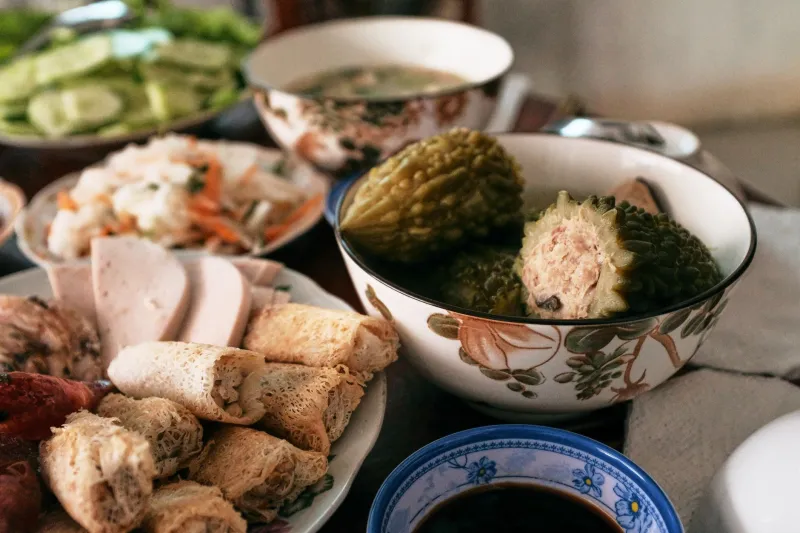
The result is a cuisine full of contradictions that somehow work. Bitter melon (goya) gets stir-fried with tofu and egg into goya champuru, a dish that sounds humble and tastes transcendent when made by someone who's been doing it for forty years. Pork is celebrated here in ways that would impress a Southern BBQ pitmaster — trotters, belly, ears, and all. Sea grapes (umi-budō), those tiny brine-popping clusters of seaweed, show up as a side dish or snack with a texture that has no real American equivalent. And the local awamori — a rice-based spirit with more kick than sake and a smoky depth — is the drink that ties any proper Yomitan meal together.
Where to Eat: A Practical Starting Point
Look for the Handwritten Signs
Yomitan doesn't have a restaurant row. Its eating establishments are scattered through the village, often tucked into converted homes or small commercial buildings with signage that assumes you already know it's there. The handwritten sign in Japanese characters outside a modest building is almost always a better indicator of quality than any English-language listing you'll find online.
That said, a few spots have earned enough local loyalty that they're worth naming. Small family-run teishoku restaurants — the kind that serve a set meal with rice, miso soup, a protein, and pickled vegetables — are the most reliable format for eating well and affordably. Lunch sets in this style typically run between 700 and 1,000 yen, which translates to roughly five to seven dollars at current exchange rates. For that price, you're eating what the person who cooked it eats at home.
The Champuru Equation
Champuru is Yomitan's comfort food in the same way that mac and cheese is comfort food in the American Midwest — everyone has an opinion on how it should be made, and everyone's grandmother made it best. The dish is a stir-fry, and the name itself roughly translates to "something mixed together," which captures the improvisational spirit of Okinawan home cooking.
Goya champuru is the most famous version, but tofu champuru and fu champuru (made with wheat gluten) are equally traditional. What makes a great champuru is the balance of textures and the quality of the lard or oil used in cooking — a detail that separates the home-kitchen version from anything made at scale.
If you have the opportunity to eat champuru cooked by a local resident rather than in a restaurant setting, take it without hesitation.
Home Cooking Traditions: The Recipes Nobody Published
The most significant food culture in Yomitan isn't in any restaurant. It lives in private homes, passed between generations through demonstration rather than documentation. Several older residents of the village describe learning to cook by standing beside a grandmother or mother and watching — measuring by eye, seasoning by taste, adjusting by intuition.
One woman in her seventies, who asked to be identified only by her first name, Fumiko, described a pre-war soup her grandmother made using every part of the pig, slow-cooked with konbu seaweed and seasoned with awamori. "She never wrote it down," Fumiko said. "I watched her make it maybe a hundred times before I tried it myself. Now I make it for New Year's and my grandchildren don't know what it is." She said it without bitterness, but the weight of that observation hangs in the air.
These disappearing recipes are part of what makes food in Yomitan feel urgent in a way that goes beyond tourism. The village's culinary identity is in active negotiation between preservation and change, and visitors who take the time to engage with it — by asking questions, by eating at family tables when invited, by learning even a few words about what they're eating — participate in something meaningful.
Sea Grapes and Other Things You Should Try
A quick checklist for the food-curious visitor who wants to move beyond the expected:
- Umi-budō (sea grapes): Available at local markets and some restaurants. Eat them fresh, at room temperature, with a splash of ponzu. Don't refrigerate them — the cold destroys the texture.
- Rafute: Braised pork belly cooked low and slow in soy sauce, awamori, and mirin until it's nearly falling apart. Rich doesn't begin to cover it.
- Soki soba: Okinawa's answer to ramen, made with wheat noodles (despite the name) in a clear pork-and-bonito broth, topped with stewed pork ribs. It's lighter than it sounds and deeply satisfying.
- Mozuku: A type of brown seaweed with a slippery texture, typically served in a vinegar dressing. Yomitan's coastal waters produce some of Okinawa's best mozuku, and locals will tell you they can taste the difference.
- Awamori: Order it on the rocks (mizuwari means with water, which cuts the intensity slightly). It's an acquired taste for some, but worth the acquisition.
How to Actually Find Good Food Here
The most practical advice for eating well in Yomitan: slow down. The village rewards visitors who aren't in a hurry. Stop at the farmers' market stalls when you see them. Step into a small restaurant even if you can't read the menu and point at what someone else is eating. Visit the local JA (agricultural cooperative) market, where produce is sold directly by the farmers who grew it, and you'll understand immediately why the food here tastes the way it does.
Yomitan's cuisine isn't performing for you. It's just being itself — and that, in the end, is exactly the point.