Same Person, Different Energy: What Yomitan Actually Does to the Way You Look and Carry Yourself
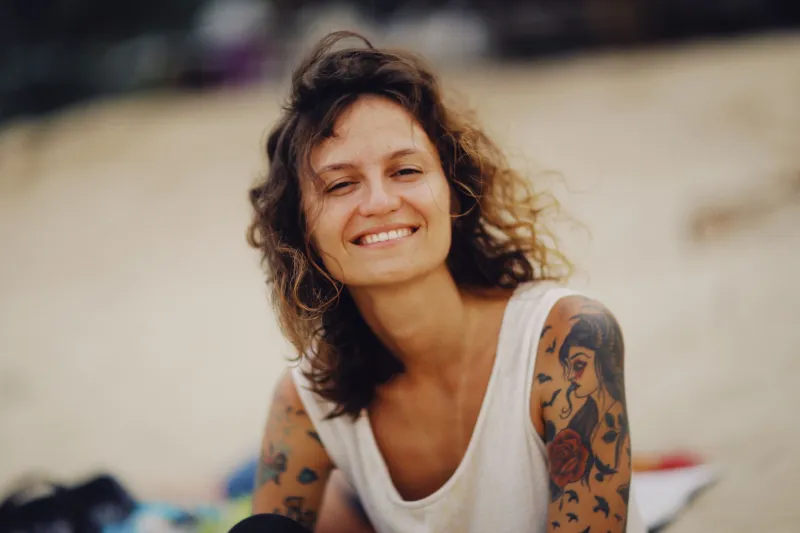
Open any long-term expat's phone and ask them to swipe back to their first week in Yomitan. They'll usually laugh — not because the photos are embarrassing exactly, but because the person staring back at them looks so tightly wound. Shoulders near their ears. A smile that's working a little too hard. Eyes that haven't quite stopped scanning for the next thing.
Then scroll forward six months. A year. Two years.
Something has clearly happened, and it's not just the tan.
The Camera Doesn't Lie, But It Takes a While to Tell the Truth
Melissa, a former marketing director from Austin who relocated to Yomitan three years ago, remembers the exact photo that made her pause. It was taken at Nirai Beach on an unremarkable Tuesday afternoon — no special occasion, no deliberate pose. A friend snapped it while she was looking out at the water.
"I looked relaxed," she says, still sounding a little surprised. "Like, genuinely. Not vacation-relaxed where you're performing relaxation for the camera. Just... settled. I hadn't seen myself look like that in probably a decade."
She's not alone in noticing the shift. Among the small but growing community of Americans who've made Yomitan their actual home rather than a two-week highlight reel, this kind of visual transformation comes up constantly — and it tends to track with real, measurable lifestyle changes rather than anything cosmetic.
Sun, Sweat, and the Slow Erasure of Desk Posture
Let's start with the obvious stuff. Okinawa's climate is relentless in the best possible way. You're outside more. You're walking more — to the market, along the seawall, through the grounds of Zakimi Castle just because it's there. The vitamin D alone is doing something your Chicago winters were actively working against.
But it goes beyond sun-kissed skin. Yomitan's layout quietly demands a different relationship with your body. There's no subway to collapse into, no escalator culture, no reason to sit in a car for 45 minutes twice a day. People walk to things. They stand at roadside stalls. They crouch in pottery studios or wade into tide pools or haul groceries up a hill on foot.
Daniel, who worked in finance in New York before moving to Yomitan two years ago, says his posture changed before his mindset did. "I didn't realize how much I'd been hunching over a laptop for years until I stopped doing it. My back just... opened up. My wife said I looked taller. I'm not taller. I just stopped collapsing into myself."
The Instagram Evolution Nobody Plans For
If you track expats' social media from their first months in Yomitan to a year or two in, a pattern emerges. Early posts are heavy on the greatest hits — the dramatic cliffside shots, the perfectly lit bowl of champuru, the selfie at every landmark. The captions are enthusiastic, slightly breathless, written for an audience back home who needs to understand that yes, this place is as incredible as it looks.
Later posts get quieter. Less curated. Someone shares a blurry shot of their neighborhood cat. A poorly lit photo of their favorite soba spot because they just wanted to remember it. A candid taken mid-laugh that they posted without fixing the angle.
"I stopped trying to make my life look good," says Priya, a remote UX designer who's been in Yomitan for eighteen months. "Not because it isn't good — it's genuinely great — but because I stopped needing to prove it. The photos I post now are for me, not for whoever's watching."
That shift — from performing a life to actually living one — has a way of registering in how people appear on camera. There's less tension in the jaw. The smile reaches the eyes more often. The body language in group photos is open rather than braced.
Stress Leaves Marks. So Does Losing It.
This part is harder to quantify but impossible to ignore. Chronic stress is physical. It lives in your face, your posture, your sleep quality, the way you hold your shoulders when you're just standing in line somewhere. Americans, particularly those coming out of high-pressure urban careers, often carry it so constantly that they've stopped noticing it.
Yomitan's pace doesn't eliminate stress — life is still life, and expats deal with plenty of logistical headaches, language barriers, and homesickness. But the ambient baseline is different. The village moves at a different rhythm. Neighbors wave. Shopkeepers remember your order. There are no honking horns outside your window at 7 a.m.
"I slept through the night for the first time in probably four years about two months after I moved here," says Melissa. "And I swear you could see it in my face within a week. My skin calmed down. The tension headaches stopped. I looked like I'd had work done, but I'd just... slept."
Vanity vs. Wellness: The Line Gets Blurry in a Good Way
Something interesting happens when the changes are genuinely coming from the inside. People stop thinking about their appearance the way they used to — obsessively, defensively, with the particular American anxiety of never quite measuring up — and start noticing it differently. Not with less interest, but with less urgency.
Priya puts it this way: "I care more about how I feel in my body now than how I look in it. And weirdly, I think I look better because of that. When you're not fighting yourself, it shows."
Daniel agrees, though he admits it took him a while to separate the genuine wellness shift from the novelty of being somewhere new. "The first three months, I thought maybe I just looked better because I was happy to be here. But two years in, it's not novelty anymore. This is just my life. And I still look better than I did in New York. That's not the vacation talking."
What Yomitan Gives You That No Wellness Routine Can Sell You
There's a whole industry built around helping Americans look and feel the way Yomitan's long-term residents describe feeling. The supplements, the fitness programs, the mindfulness apps, the skincare routines. Some of it works. Most of it works better when the environment it's fighting against isn't actively undoing it every day.
Yomitan isn't a cure-all. People still have hard days, bad photos, moments where they catch themselves in a mirror and feel nothing like their best self. But the conditions here — the movement, the light, the pace, the community, the food — seem to work together in a way that's hard to manufacture anywhere else.
Scroll back through enough expat camera rolls and you start to see it clearly. Same person. Different energy. Something about this village has a way of returning people to themselves — and it turns out that looks pretty good on camera.